Overview
The Rohingya people are a stateless Muslim minority in the western Myanmar state of Rakhine. They have been forced out of Myanmar (also known as Burma) by violence and racism for more than 20 years. Myanmar’s government refuses to recognize the Rohingya people as one of the 135 official minority groups in the country, denying them citizenship as long as they identify as Rohingya. The most recent crisis began in August 2017 when hundreds of thousands of Rohingya people — more than half of whom were children —fled violence against them by seeking refuge in neighboring Bangladesh.
Currently estimated to include a million people, most of these refugees have settled in the Cox’s Bazar region of Bangladesh, living in sprawling refugee camps. The largest camp houses as many people as the City of Baltimore but in a space that is only five square miles (13 square kilometers).
On Monday, March 22, 2021, a large fire swept through the Balukhali camp before spreading to two other camps, consuming 500 acres and destroying 10,000 encampments. At least 45,000 people are homeless and as many as 400 are missing, along with nearly 600 injured and 15 killed. Aid workers and refugees alike blame barbed wire in the camps for preventing people from fleeing quickly.
This was the latest in a series of fires that have swept the camps, leading to fears that the government is trying to push residents to leave. A fire on Jan. 14, 2021 gutted the Nayapara refugee camp in Cox’s Bazar, destroying 550 shelters and 150 shops and leaving approximately 3,500 people homeless. The Bangladeshi government is trying to get refugees to move to a remote island in the Bay of Bengal. Bangladesh developed the island specifically for the purpose of helping to resettle Rohingya Refugees and move them out of temporary refugee camps in the Cox’s Bazar region. On Sept. 12, 2020, Bangladeshi officials took a group of 47 Rohingya leaders to assess the suitability of a site for the planned relocation of up to 100,000 Rohingya refugees. By the end of March 2021, more than 13,000 Rohingya had been moved to the island of Bhasan Char. Although they have been promised safe and secure shelter, along with access to other supports including food and health services, aid workers say the island is in the path of cyclones. Despite an improvement in living conditions, the Rohingya on Bhasan Char are prisoners, unable to leave the island without permission from the government of Bangladesh.
These temporary settlements in Cox’s Bazar were put up very quickly, leading to concerns about WASH (Water, Sanitation and Hygiene), shelter and safety for women and girls. On Aug. 24, 2020, Save the Children released a statement that estimated more than 100,000 babies have been born in refugee camps in Bangladesh and Myanmar. As a result, these children are at higher risk for malnutrition, health problems and missing important educational opportunities. As of Oct. 31, 2020, the United Nations High Commissioner for Refugees (UNHCR) was tracking just over 850,000 Rohingya in the refugee camps, of which 570,000 have received direct support from WFP.
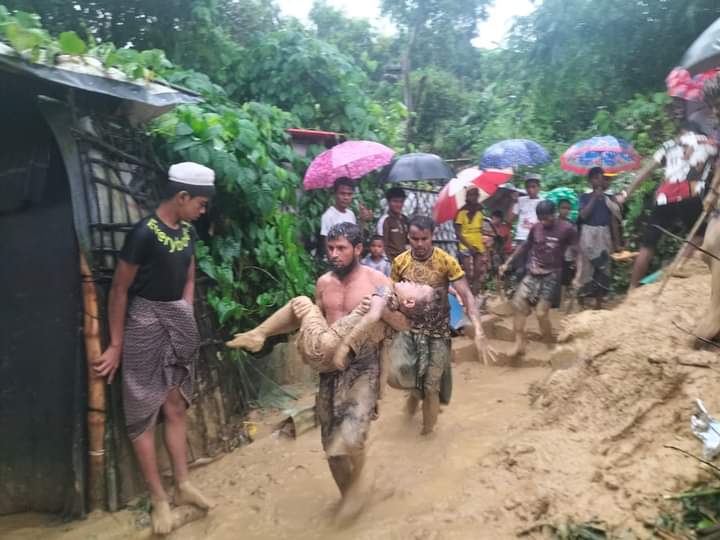
The summer seasonal monsoons brought flash floods and soil erosion that made the living conditions in refugee camps more precarious. It caused significant damage to shelters and infrastructure in refugee camps that affected more than 4,500 people. The response and reconstruction were handled by refugees in the camps with support from UNHCR and other partners. Refugee volunteers were empowered to take the lead in the emergency response, performing water rescues and evacuating people from affected structures.
The arrival of COVID-19 in the Cox’s Bazar area raised concerns about the health of the Rohingya refugees occupying the settlements. The tight spaces, accompanied by the lack of access to basic services, especially healthcare, leave those residing in Cox’s Bazar especially vulnerable to the virus. As a result of these concerns, Bangladesh imposed a complete lockdown on Cox’s Bazar with only critical aid and healthcare staff being allowed to enter and exit the area. Aid agencies working in Cox’s Bazar have mobilized Rohingya volunteers to support hygiene and prevention messaging in order to avoid the spread of COVID-19. As they work to limit the spread within the camps, relief and response workers have started transitioning away from collective points of distribution into delivering supplies directly to the households of people at high-risk of COVID-19.
The first case of COVID-19 in Cox’s Bazar was confirmed on May 15, 2020, with the first death confirmed on May 30, 2020. Despite the close quarters and conditions in the camps, there have been only 10 deaths and 400 COVID-19 cases since the pandemic started, out of 30,000 tests conducted. In addition to the toll COVID-19 is taking on the physical health of Rohingya refugees, the increased restrictions on aid and aid workers have also reduced the amount of mental health support available to these displaced people.
Hopes for the repatriation of the Rohingya to their traditional lands have risen with the re-election of the National League for Democracy during November 2020 elections. Many countries and organizations around the world, including China, the U.S., the European Union and the United Nations are pushing Myanmar President Aung Suu Kyi to repatriate the Rohingya in circumstances that will allow them to thrive.
Critical Needs
- Sexual and Gender-Based Violence Prevention and Response: The United Nations (UN) says, “Assessments indicate that adolescent Rohingya girls’ risk of gender-based violence (GBV) has increased since the onset of the COVID-19 pandemic. In response, UNHCR will newly implement ‘Girl Shine’ in 2021 through its partners BRAC and Relief International. As a first step to implementing the new programme, a training-of-trainers took place where 21 participants learned about the programme’s tools and core concepts. These staff members will facilitate the programme for the first cohort of girls in the camps after tool adaptation is complete. The programme model, originated by the International Rescue Committee, works with adolescent girls and their caregivers, building the girls’ life skills, social networks, and knowledge about GBV, enabling them to better protect themselves and their peers.”
- Water, Sanitation and Hygiene Facilities: While a large number of handwashing taps were installed in households, COVID-19 delayed plans of many organizations to install sanitation facilities.
- Unrestricted Financial Support to Responding Agencies: In addition to the UN, there are at least 27 operational nongovernmental organizations (NGOs the UNHCR refers to as partners) working to support UNHCR during this complex humanitarian emergency. With much of the philanthropic support and attention of the world focused on COVID-19, support for ongoing humanitarian emergencies is key.
- Support for Camp and Building Design and Construction: The vast majority of these structures were built without planning or preparation to ensure their long-term viability. As a result, they are susceptible to flooding and unstable slopes, particularly during the monsoon season. UNHCR is working with other agencies to ensure the long-term stability of these structures as there is no end in sight to this complex humanitarian emergency.
Contact
If you are a responding NGO or a donor, please send updates on how you are working in this crisis to tanya.gulliver-garcia@disasterphilanthropy.org.
If you are a donor looking for recommendations on how to help in this crisis, please email regine.webster@disasterphilanthropy.org.
Credit: here