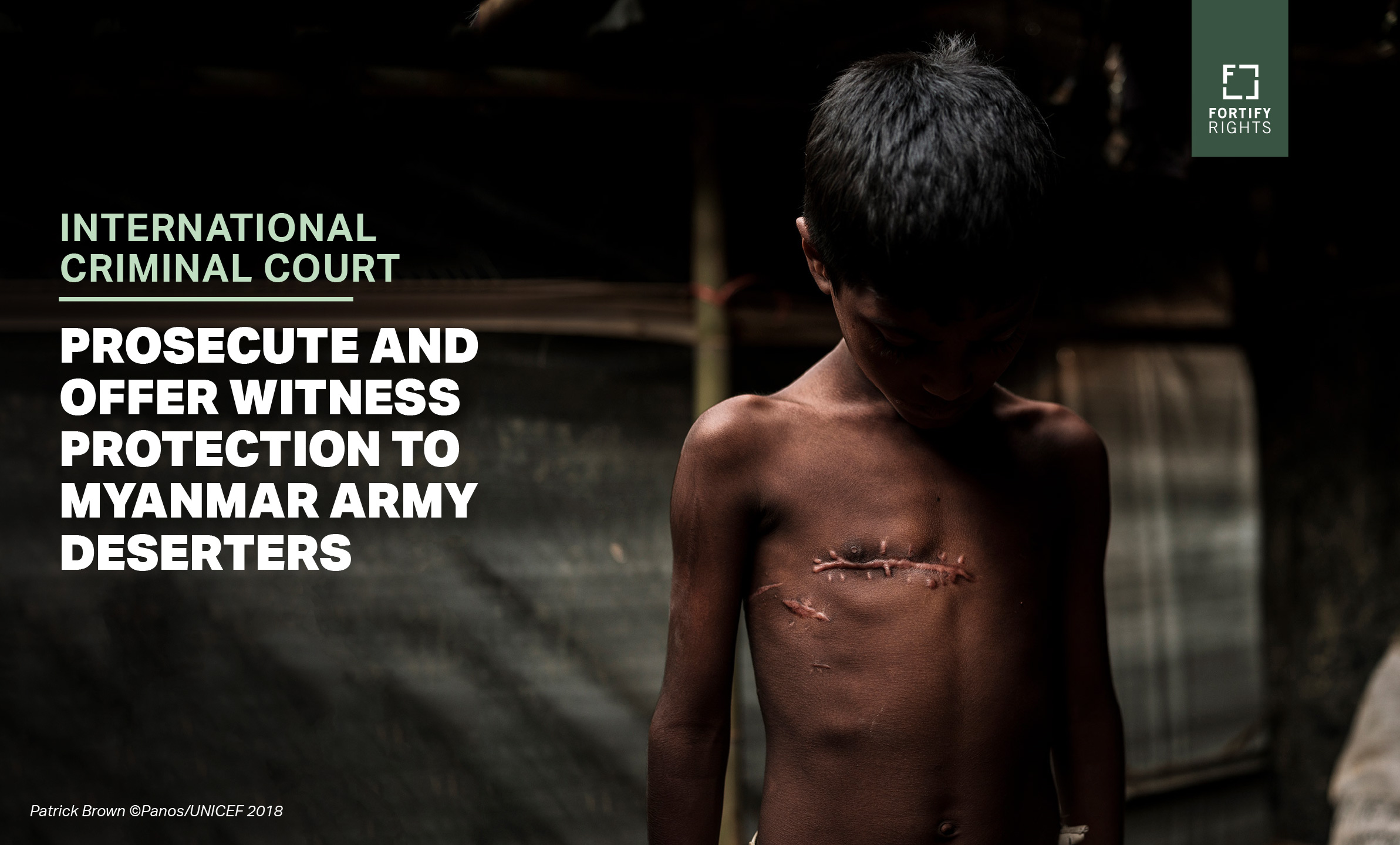
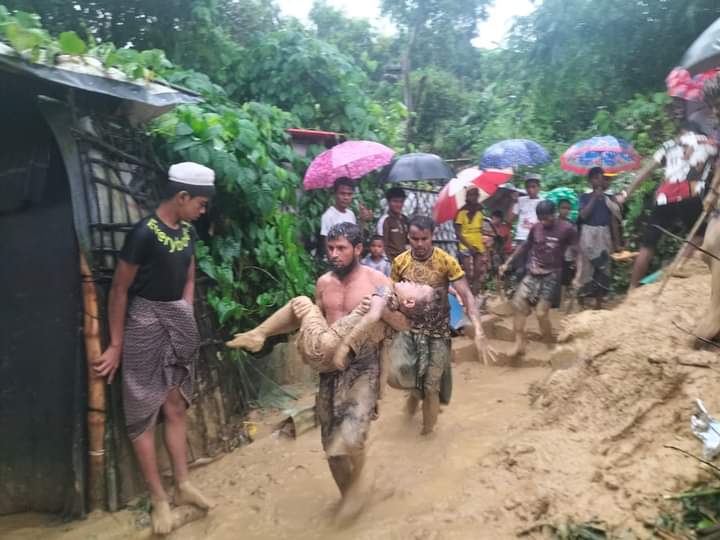
| In 2018, Fortify Rights published evidence that Myanmar Army soldiers raped Rohingya women, killed Rohingya men, women, and children, buried bodies in mass graves, and systematically destroyed properties, villages, and food stocks in northern Rakhine State in 2016 and 2017. Fortify Rights documented atrocity crimes by Myanmar Army soldiers in places mentioned by Zaw Naing Tun and Myo Win Tun.
“Rahana,” 30, fled her home in Kyet Yoe Pyin, also known as Kiari Farang—a village in which Private Zaw Naing Tun was operational—with two children on August 26, 2017. She arrived in Bangladesh on August 30, 2017, and on that day she told Fortify Rights:
The military came to the village, and they were beheading, cutting, and chopping people. My husband and father were killed. . . . It was very noisy from gunfire. We could see the military shooting into the village, and we could see dead bodies. There were women, men, children. When we were leaving, we saw some flesh, cut into pieces, and we saw some dead bodies were lying around, scattered in different places. It was in the field. There were around 20 dead bodies, scattered.
Fortify Rights documented how Myanmar Army soldiers threw infant children into fires in Kyet Yoe Pyin village. “Wai Ni,” a 35-year-old Rohingya mother of eight from Kyet Yoe Pyin, told Fortify Rights how Myanmar Army soldiers grabbed her two-year-old daughter from the arms of her 14-year-old daughter and threw her into a fire. She said: “We were standing nearby, but we were not allowed [to] grab the body out of the fire. We were screaming, hoping the military would not harm others. We could save [my older daughter] but not [the younger one].”
Several Rohingya survivors described to Fortify Rights the existence of mass graves in Kyet Yoe Pyin village.
The Independent International Fact-Finding Mission on Myanmar similarly documented killings of infants and children in Kyet Yoe Pyin village as well as “a particularly brutal level of sexual violence” in the village, where “[w]omen and girls were subjected to mass gang rape, forced nudity, sexual humiliation and sexual assault.”
In his confession, Zaw Naing Tun says he served as a sentry guard for superior officers when they raped Rohingya women in Kyet Yoe Pyin. He says: “I witnessed Sergeant Pyae Phyoe Aung and Corporal Shwe Htwe rape three kalar–ma [Rohingya women] when we implemented the clearance operations in Kyet Yoe Pyin village.”
On September 6, 2018, the ICC granted the Chief Prosecutor jurisdiction to investigate and possibly prosecute the crime against humanity of forced deportation of Rohingya to Bangladesh, as well as persecution and other inhumane acts.
The U.N. Security Council should immediately refer the situation in Myanmar to the ICC, enabling the court to investigate and prosecute all of the crimes perpetrated against Rohingya, including the crime of genocide, said Fortify Rights.
Given their confessions and apparent transfer to The Hague, it is reasonable to assume Myo Win Tun and Zaw Naing Tun could plead guilty to the crimes to which they confessed in exchange for becoming “insider witnesses” for future trials. Such a development would significantly advance efforts to hold perpetrators accountable for atrocity crimes against Rohingya, said Fortify Rights.
The ICC has a witness protection program for various types of witnesses, including “insider witnesses.” Under Article 68(1) of the Rome Statute, the ICC is obligated to “take appropriate measures to protect the safety, physical and psychological well-being, dignity and privacy” of witnesses, and under Article 43(6), a victims and witnesses section at the ICC is responsible for “protective measures and security arrangements” for at-risk witnesses.
“We hope the willingness of these men to come forward carries like a wave of justice across the Myanmar military and officialdom,” said Matthew Smith. “More soldiers and government insiders in the country should come forward with information. There are systems in place to protect their rights.”
|